

















UCAS 2026|报英国大学写Personal Statement新要求 申请人要答这3条问题 (附范例文章)
发布时间:15:19 2026-01-06 HKT


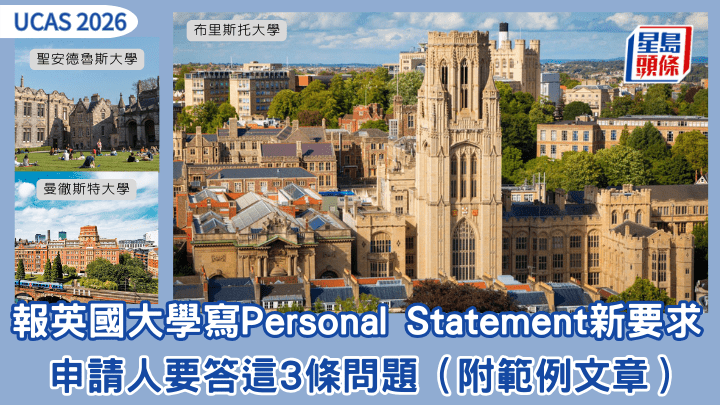
UCAS 2026|英国向来是香港学生热门的留学国家之一,除了历史因素,当地有不少历史悠久且学术声誉卓越的大学,都是吸引香港学生到当地升学的原因。香港学生报读英国大学,需透过联招系统UCAS(Universities and Colleges Admissions Service)申请,流程类似香港的JUPAS。牛津大学、剑桥大学,以及大部分医科、牙科和兽医学课程,已于去年10月15日截止申请,而大多数大学的本科课程,则于今年1月14日英国时间下午6时截止。有海外升学顾问表示,学生今年申请英国大学时,需撰写的Personal Statement(个人陈述)格式有变,提醒同学要注意。
UCAS 2026|Personal Statement格式新要求
现时,接近全英国的大学均需透过UCAS平台申请,无论本地或国际学生均适用。申请人最多可选择5个课程(可来自同一大学或不同大学),提交后UCAS会将完整资料转发相关大学审核,录取结果亦于平台显示。据UCAS官方网页资料, 2025年1月截止的申请人数(英国及国际学生)达600,660,较2024年增加约0.96%。
LINKEDU 升学中心创办人吴语庭(Adrian)表示,「过去10年UCAS申请流程变化不大,今年最明显的更新是Personal Statement格式改革,但对整体选校及申请影响不大。」他表示,新制不再要求申请人撰写长篇的个人陈述,而是改为回答3条结构化问题,让申请流程更简洁,并引导学生提供招生官最想看到的资讯。
「这3条问题分别为:1. 你为何对这个课程或学科感兴趣?2. 你的学历及经验如何帮助你准备好修读这个课程?3. 除了学业,你还做了哪些课外准备,这些经验又有何帮助?」每题最少350字元,3题总和不超过4,000字元。Adrian强调,答案必须原创,绝对不可抄袭。
UCAS 2026|3大申请注意事项
Adrian根据多年协助学生申请英国大学的经验,整理出以下3大重点:
1.认真准备Personal Statement及推荐信(Reference)
Personal Statement是招生官了解申请者的主要途径(除预计成绩外)。内容应展示对学科的真诚热诚、相关经验(如实习、工作影子计划、课外活动)及个人成长,并以具体事例佐证,避免空洞描述。同时,需尽早邀请合适老师撰写推荐信,并确保于提交申请前完成。
2.有策略地选校并预留后备方案
虽然UCAS不设选择优先次序,但Adrian建议学生心中预先排好顺序,便于日后选定Firm Choice(首选)及Insurance Choice(后备)。他不主张全选「稳阵」学校,反而鼓励稍为进取。「后备途径其实相当多,例如部分大学接受Direct Entry,亦可考虑Foundation或International Year One课程。公开试放榜后,更可透过UCAS Clearing阶段补位。」一般建议是有1至2间保守选择,搭配3至4间具挑战性的学校,具体策略可与专业顾问讨论。
3.留意特定学科的额外入学要求
不同学科或有额外考试,须提前准备。例如,部分法律课程要求LNAT;伦敦政治经济学院(LSE)等大学的经济或数学相关课程,可能需考TMUA(Test of Mathematics for University Admission)。
UCAS 2026|报读英国大学2个常见错误
1.写Personal Statement未能针对报读课程
Adrian指出,不少学生在Personal Statement中详列个人经历或成就,却未能清楚解释这些经历如何激发对学科的兴趣,或如何有助未来学习。例如,报读法律课程的申请人,提到曾参与义工,却未说明如何加深对法律的理解,便难以打动招生官。他认为,一篇优秀的Personal Statement应透过具体事例,展示热情源于真实体验,并与学科建立明确连结。
2.未查清楚课程申请资格
另一常见失误,是未查清楚课程是否接受国际学生或是否必须经UCAS申请,便贸然放入选择,浪费宝贵的5个名额。
Personal Statement范文例子
Adrian特地为有意到英国升学的申请者撰写以入读法律课程为例的Personal Statement范文,同学可作参考。内文如下:
1. Why do you want to study this subject?
From a young age, observing how different communities in Malaysia navigated questions of identity and access to public services made me question who truly “belongs” and on what terms. These experiences led me to interrogate how law can entrench cultural dominance and shape everyday life for minorities. In Malaysia, the contrast between the “Truly Asia” image and constitutional provisions such as Article 153, which grants the Bumiputera majority particular privileges, drew my attention to the gap between formal equality and lived reality. Through Gramsci’s concept of cultural hegemony and Haque’s ‘The Role of the State in Managing Ethnic Tensions in Malaysia’, I began to see how notions of “citizenship” and “culture” can be manipulated via Article 153 and policies like the New Economic Policy to create implicit hierarchies of belonging.
Galvanised by these questions, I explored how fundamental liberties are overtly limited to protect religio‑cultural norms. During an internship with the Malaysian Parliament, I saw how cultural expectations, once codified into the Federal Constitution, can constrain the right to freedom of religion under Article 11. Independent research for an article titled ‘Apostates in Malaysia’, later published by human rights organisation SUARAM, allowed me to analyse how the criminalisation of apostasy and the recommendation of severe penalties for divergent beliefs sit uneasily alongside Article 11’s guarantee of religious freedom. The resulting paradox, which appears to undermine the uniform application of law that Dicey describes in The Law of the Constitution, convinced me that a legal lens is essential to understand anthropological tensions and to design more coherent, just policy in plural societies.
1756 characters
2. How have your studies and qualifications prepared you?
My academic work has consistently returned to themes of citizenship, identity and the unequal distribution of rights. Studying subjects that required close textual analysis and critical writing, such as History and Sociology trained me to unpack complex arguments and interpret legal and political texts with precision. In History, my coursework on the rise and fall of European empires introduced me to archival research and competing narratives about how law is used to justify power and maintain control. Engaging with theoretical frameworks alongside the above, including Gramsci’s ideas on hegemony and Dicey’s account of constitutionalism, has helped me connect abstract theory to concrete case studies. This has prepared me to approach anthropology with both conceptual rigour and sensitivity to context.
Generally, producing longer essays and independent projects has taught me how to formulate questions, synthesise sources and construct coherent, evidence‑based arguments, skills that will be directly applicable to legal writing at university.
1054 characters
3. What else have you done to prepare, and why is it useful?
To consolidate my interest in law and rights in practice, I interned at xxx, a family law firm. There, I observed how jurisdictional limits can leave non‑citizens with restricted access to essential services such as healthcare and education, sharpening my awareness of the everyday consequences of legal boundaries. This experience demonstrated how formal rules intersect with social assumptions about who deserves protection, reinforcing my interest in the relationship between legal status and lived belonging.
Seeking to create spaces for discussion among my peers, I founded my school’s first law society. I organised talks and debates on human rights and constitutional issues, encouraging students to re‑evaluate legislation through an intersectional lens. Planning and chairing these events developed my leadership, public speaking and organisational skills, as well as my ability to communicate complex ideas clearly to different audiences. To hone my creativity, I also designed activities and discussions that drew on multiple disciplines, from politics and history to sociology, mirroring the interdisciplinary nature of anthropology.
1163 characters
Total : 3973 characters
(文章只作参考用途)
文章来源:LINKEDU 升学中心
延伸阅读:
DSE选科︳DSE、A-Level选科黄金秘诀:升学规划要「以终为始」 4大大学学系对应科目︳海外升学
给双申英美大学「双申」家庭3个建议:录取季进行时从容规划每一步 ︳海外升学
有!可于2月26日起进入UCAS Extra阶段,逐一添加新选择。
可在提交后14天内联络UCAS,更改一次选择。